







The Grand Egyptian Museum
In the heart of Giza, just a few steps from its towering Pyramids, the Grand Egyptian Museum (GEM) rises as the largest cultural and civilizational edifice in the world dedicated to a single civilization. This project was not merely a building to display artifacts, but an ambitious national vision embodying Egypt’s determination to re-present its history to the world in a manner befitting the grandeur of its ancestors.
Since its conception more than two decades ago, the Grand Egyptian Museum has transformed into a symbol of the cultural and touristic revival of modern Egypt, and a destination that attracts millions of visitors annually from all over the world, to live a unique experience that combines history, art, and technology simultaneously.
The Strategic Location and Selection
The Museum’s location was chosen with extreme care, on the Giza Plateau, at the meeting point of modern Cairo and the ancient Pyramids. This short distance separating the Museum from the Pyramids—less than two kilometers—carries a deep symbolic meaning:
- It is not just a place to display relics of the past, but a living extension of a history that began more than 7,000 years ago.
The selection came as a result of precise studies conducted by the Supreme Committee overseeing the project, which wanted visitors coming to Egypt to be able to see the sequence of civilization before their eyes:
- From the moment they view the Pyramids on the horizon, through the Museum that tells the stories of their makers, to the heart of Cairo which represents the vibrant present.
The location is also distinguished by its easy accessibility via modern highways, and its proximity to the new Sphinx International Airport, making the Museum a pivotal point of attraction on Egypt’s tourism map, and a fundamental pillar in the State’s plan to transform Giza into an integrated global tourist zone.
Project Idea and Implementation Beginnings
The Grand Egyptian Museum
The idea of establishing a massive new museum began in 1992, when experts realized that the Egyptian Museum in Tahrir was no longer capable of accommodating the increasing archaeological treasures discovered annually.
By 1998, the Egyptian Ministry of Culture announced an international competition to design the largest archaeological museum in the world dedicated to Ancient Egyptian civilization.
More than 1,500 engineering offices from 83 countries applied for the competition, and the design submitted by the Irish office Heneghan Peng Architects won the first prize in 2003.
In 2005, the foundation stone was laid, and the actual planning and implementation phase began under the leadership of the Egyptian Ministry of Antiquities and direct supervision from the Egyptian Government, with international funding from prominent institutions, notably:
- The Japan International Cooperation Agency (JICA), which financed the project with a concessional development loan of approximately 800 million US dollars.
- The Egyptian Government, which contributed a large percentage of the construction and infrastructure cost.
- The Armed Forces Engineering Authority, which undertook the management of the implementation stages and coordination among the working companies.
Construction Stages and Timeline
The construction of the Grand Egyptian Museum lasted nearly twenty years, a period considered one of the longest for major global museum projects, due to the project’s magnitude and the precision of its details.
Here are the most important implementation stages:
First Stage (2005 – 2010):
- Included excavation, leveling work, preparation of the infrastructure for the site extending over an area of 480 thousand square meters, in addition to implementing the concrete structure of the main building.
Second Stage (2011 – 2015):
- The project faced challenges due to the political unrest witnessed by Egypt, leading to a temporary slowdown in implementation. Nevertheless, the work on preparing the foundations and developing the International Restoration Center within the Museum continued—which is today considered one of the largest restoration centers in the Middle East.
Third Stage (2016 – 2020):
- This stage witnessed a boom in implementation, with the completion of the triangular glass façade and the installation of smart systems for lighting and climate control inside the halls.
- Thousands of artifacts were also transferred from the old Museum to the new one in a complex process that took more than four years.
Fourth Stage (2021 – 2025):
- This stage was dedicated to final finishes, technical preparation for the museum display, and training on visitor systems and trial operation.
In total, the project took more than 22 years from idea to opening, truly making it the longest continuous cultural project in modern Egyptian history, and the result of unique international and local cooperation.
Architectural Design
The winning design is considered one of the most creative architectural projects in the world.
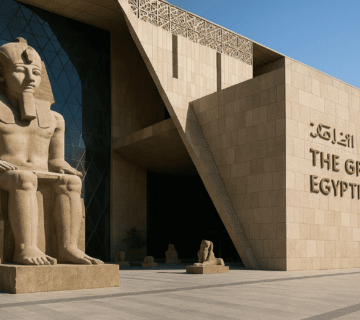
The architects were inspired by the idea of the triangular façade from the shape of the Pyramids themselves, so that the Museum overlooks at a geometric angle allowing the visitor to see the Three Pyramids from behind the large glass that adorns its facade.
The most prominent design features:
- The main façade is made of semi-transparent stone panels that change their color with the sunlight to give the building a varying light life throughout the day.
- The Grand Staircase extends for more than 60 meters, flanked by colossal statues of ancient Egyptian kings, for the visitor to experience a “journey up through history.”
- The Grand Hall welcomes the visitor with the statue of Ramesses II, 11 meters high and weighing 83 tons, which was specially moved from Ramesses Square to the Museum in a stunning engineering operation in 2018.
- The Museum consists of 5 tiered levels representing a timeline of Egyptian civilization, starting from the predynastic eras until the end of the Pharaonic rule.
- It contains an integrated research and restoration center equipped with specialized laboratories for wood, metals, textiles, bones, and papyrus, under the supervision of Egyptian and Japanese experts.
This design does not just present a building for displaying artifacts, but an integrated visual and emotional experience that embodies the philosophy that architecture itself can be a “language that narrates history.”
Collections and Archaeological Treasures
Collections and Archaeological Treasures
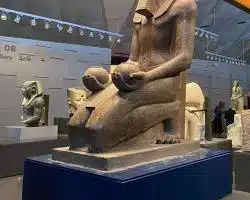
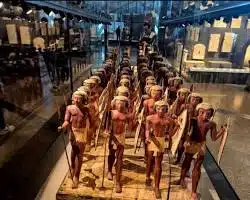
The Museum houses more than 100,000 artifacts, with about 50,000 displayed to the public and the rest in research storage.
Among the most notable collections:
- The complete Tutankhamun collection—displayed for the first time in its entirety in one place, including more than 5,000 pieces, among them the famous golden sarcophagus, the golden mask, and the royal chariot.
- Colossal statues of kings from the New and Middle Kingdoms.
- Rare pieces from the Predynastic era that illustrate the genesis of ancient Egyptian art.
- Collections of daily life such as agricultural tools, jewelry, and medical manuscripts.
- The Royal Mummies Hall displayed in a way that respects the human and historical aspect, away from the intimidating nature previously associated with them.
The pieces underwent meticulous restoration processes inside the Restoration Center equipped with the latest X-ray and laser devices, to ensure their display in the best form without compromising their historical authenticity.
The Tourist Experience inside the Museum
A visit to the Museum is not just a cultural outing, but a sensory and interactive journey that begins from the moment you enter the outdoor plaza adorned with giant sculptures and dancing fountains.
Upon entering the Grand Hall, the visitor finds himself in front of the statue of Ramesses II in a majestic reception, while the stairs extend behind him toward history.
The experience includes:
- Multi-lingual audio guides (Arabic, English, Japanese, French).
- Dedicated areas for children to learn about Egyptian civilization in an enjoyable way.
- Digital display halls relying on Augmented Reality (AR) technology to illustrate scenes from Pharaonic life.
- Restaurants and cafés with a direct view of the Pyramids.
- Shops for luxury souvenirs and jewelry inspired by the artifacts.
The Museum also provides specialized visit programs for schools and universities, and special tours for historians and researchers, with facilities for people of determination.
Who Oversaw and Contributed to the Project’s Implementation
The Grand Egyptian Museum was the fruit of cooperation between many institutions, both local and international, including:
- Egyptian Ministry of Tourism and Antiquities (The main responsible party for the project).
- Armed Forces Engineering Authority (The implementing and field supervisory body).
- Japan International Cooperation Agency (JICA), the main funder.
- The Egyptian-Japanese Alliance which included companies such as Orascom and Arab Contractors.
- Heneghan Peng Architects office for engineering design.
- The American firm Hill International for project management and technical supervision.
This diversity made the project a model for international cooperation in culture and architecture and highlighted the competence of Egyptian cadres who undertook the implementation with global precision.
The Museum as a Symbol of Development and National Identity
The goal of the Museum was not merely to display artifacts, but to present a new vision for the role of culture in development.
On the economic level, the Museum provides thousands of direct and indirect job opportunities in the fields of tourism, restoration, and services.
On the cultural level, the Museum enhances the connection of Egyptian youth to their heritage through educational experiences and workshops.
On the touristic level, the Museum is expected to attract more than 5 million visitors annually, making it one of the pillars of Egypt’s national income from tourism.
The Museum also represents a symbolic message: that Egypt does not just possess the past, but knows how to present it to the world in the style of the future.
Innovation and Modern Technologies
The Grand Egyptian Museum is not just a place that displays artifacts, but a center for Museum Innovation.
Its designers used the latest technologies such as:
- Smart lighting systems that adapt to the type of pieces on display.
- Humidity and temperature control systems to preserve sensitive artifacts.
- The use of Virtual Reality (VR) to embody scenes from the lives of ancient Egyptians.
- Interactive screens that allow the visitor to touch images, magnify details, and watch the restoration of pieces in real-time.
The Future and Long-Term Vision
The vision of the Grand Egyptian Museum goes beyond being a tourist destination. It seeks to become:
- A global platform for cultural exchange between Egypt and the rest of the world.
- A center for research and education in the sciences of archaeology and restoration.
- A sustainable destination relying on solar energy and smart systems to reduce the carbon footprint.
In the near future, the Museum plans to launch a smart application that allows booking virtual tours and tickets electronically, in addition to partnerships with global educational institutions to teach Egyptology.
An Invitation to Visit: Live History Through the Eyes of the Future
A visit to the Grand Egyptian Museum is not just a viewing of ancient relics, but an experience that redefines the meaning of a journey through time.
In every corner of its halls, in every statue and golden piece, there is a story narrated in the language of art and greatness.
It is the place where Egyptian civilization re-presents itself to the world—not as a memory, but as a living reality pulsating with life.
If you are planning to visit Egypt, make the Grand Egyptian Museum your first stop.
And enlist the help of our company’s experts to organize an integrated tour that includes the Museum, the Pyramids, and Giza Safari, to live an unforgettable experience that combines history, beauty, and adventure.


No comment